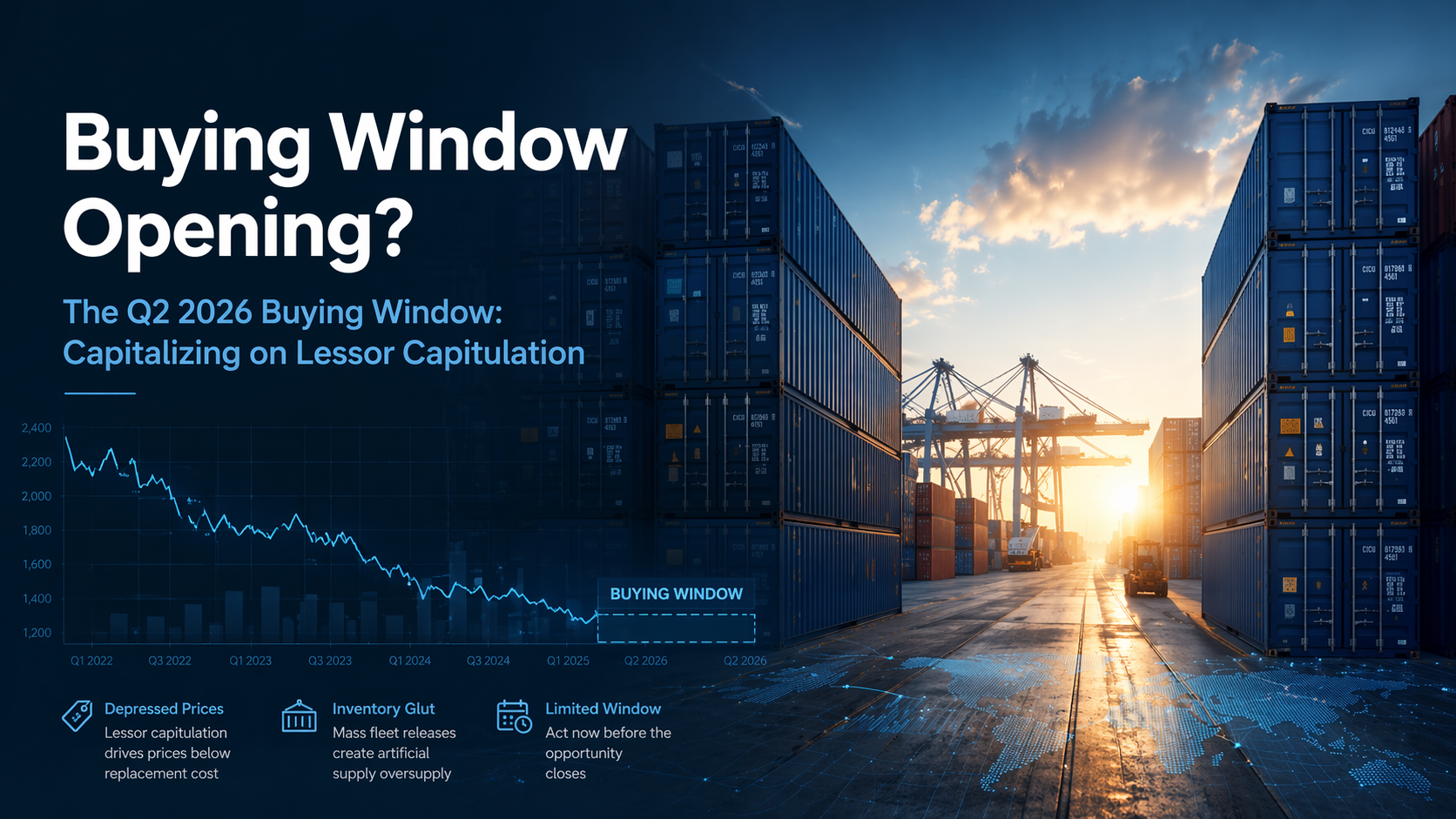
The Q2 2026 Buying Window: Capitalizing on Lessor Capitulation
The Q2 2026 Procurement Imperative: Why Lessor Capitulation Has Created an Immediate Buying Window
Navigating structural decoupling and securing dumped inventory below global replacement costs.
Executive Summary
As we enter the second quarter of 2026, the North American container market has entered a phase of severe structural dislocation. The market is defined by a panic-driven, massive fleet release by major leasing conglomerates.
Faced with soaring terminal demurrage and mounting daily yard storage costs, these entities are aggressively dumping both New (One-Trip) and Used (Cargo Worthy) equipment into the wholesale and retail secondary markets. The key change versus late Q1 is the transition from a gradual price softening to a full-scale volume dump.
Market Reality Check
To understand why this buying window exists, procurement teams must separate macro-level illusions from micro-level realities.
Global macro indicators point to tightening supply. The ongoing geopolitical crisis in the Middle East and the effective closure of the Strait of Hormuz have driven ocean spot rates and bunker adjustment factors (BAF) to exceptional highs. In a standard market, this would directly translate to higher physical container prices.
However, the micro-level reality is completely decoupled. While it is incredibly expensive to put a new container on a ship today, prices for containers already sitting in U.S. depots are plummeting. This is due to acute geographic misallocation and crushing storage pressure.
Buying Window Analysis
The justification for immediate procurement is grounded in the underlying mechanics of container pricing and replacement cost.
New (One-Trip) container pricing in the U.S. interior is currently dictated by liquidation. Mid-April vendor data confirms a single top-tier lessor is holding over 800 units of 20' New containers in Chicago alone, slashing prices to the $1,500–$1,600 range. This is a synthetic floor, not a true cost reflecting Asian manufacturing plus 2026 ocean/rail freight.
The Used-to-New Price Ratio (UNPR) typically sits near 60%. With new containers dumped in Chicago at $1,500, CW units have dropped in tandem to the $900 mark. The used market has perfectly synchronized with the artificial drop in the new market.
Waiting for prices to drop further is a deeply flawed perceived downside. The real downside is that the price has already hit the absolute bottom—the point where lessors will simply hold for domestic leasing or scrap rather than reduce further. Once this dumped inventory clears, the market will abruptly reset to the true, much higher replacement cost.
Key Market Drivers
- Inventory Accumulation & Release: The aggressive fleet release by major lessors has saturated specific nodes. This volume release from the East Coast and Midwest hubs is the primary engine of the current buying window.
- Freight Economics & The Inland Logistics Penalty: High ocean rates subsidize inbound trips, but penalize domestic buyers. With Brent crude sustaining above $107 per barrel, fuel surcharges for trucking and rail have exploded. Trapped oversupplied markets cannot bleed off their excess inventory to other states efficiently, forcing local prices down.
- Demand Conditions (The SOC Imperative): Shipping lines are aggressively penalizing shippers and restricting the release of empty Carrier Owned Containers (COCs) to maximize turnaround times. Exporters and NVOCCs are realizing they must procure Shipper Owned Containers (SOCs) to keep supply chains moving. This captive demand will soon devour the dumped inland inventory.
Regional & Structural Interpretation
Buyers must look beyond the nominal price and recognize where the true arbitrage lies. A $950-$1,000/20' CW/IICL (newer) container in the New York/New Jersey area is an unprecedented opportunity—but strictly for those with the right capabilities. While buyers relying on weak third-party logistics might struggle with terminal congestion or delays, companies with strong drayage power and efficient extraction capabilities can bypass these hurdles entirely. If you have the operational logistics in place to pull this equipment swiftly, you are effectively securing an asset at an unbeatable discount, locking in massive margins that your competitors simply cannot reach.
Segment-Specific Strategy
Wholesalers
Target CW block deals in coastal ports and One-Trip units in the Midwest. Go directly to the hubs where major lessors are bleeding storage fees and negotiate volume block deals immediately. Ensure you have downstream retail channels lined up to prevent capital lock-up.
Retailers
Lock in your Q2 and early Q3 inventory now. Secure physical assets from your local depot while the wholesale price is artificially depressed. Do not attempt cross-country arbitrage; the $107 oil inland logistics penalty will erase your margin.
End-Users
Modular construction companies and SOC shippers must execute capital expenditure budgets immediately. A container is the cheapest square footage you can buy right now given skyrocketing steel and labor costs. For exporters, buying SOCs is no longer an option; it is mandatory for survival.
30-90 Day Outlook
| Scenario | Market Conditions & Forecast | Conditions for Change |
|---|---|---|
| Base Case (Most Probable) |
Within the next 30-45 days, aggressive block-buying and surging demand from exporters forced into the SOC market will absorb the dumped inventory. Once this localized surplus evaporates, pricing will abruptly snap back to true replacement cost. | The only condition that would shift this "Immediate Buy" recommendation to "Wait" is a sudden, miraculous resolution to global geopolitical conflicts, resulting in shipping lines repositioning empty containers inland at zero cost. This is highly improbable in Q2. |
| The Buying Window | The buying window is closing fast. Capturing the artificial surplus before it clears is the only viable procurement strategy. |
Final Recommendation
The evidence is unequivocal, and the market dynamics are clearly defined. We are looking at a localized, storage-driven capitulation by major leasing companies that has dragged container prices significantly below their true replacement cost.
This is an Immediate Buy Window. Customers, whether wholesalers, retailers, or end-users, must stop spectating and abandon the hope of further incremental discounts. Execute your procurement orders immediately before the artificial surplus is absorbed and the extreme costs of 2026 logistics reinstate a much higher, permanent price floor.
Sources & Methodology
This report synthesizes data strictly from verified, proprietary offline channels to provide an unfiltered view of the physical container market, bypassing the lag of macro indicators:
- Lessor Fleet Release Data: Proprietary snapshots of available inland (Chicago, etc.) and coastal (NY/NJ, etc.) depot inventory from major top-tier lessors (e.g., T-company, S-company) as of April 13-14, 2026.
- Real-Time Wholesale Matrices: Cross-validation of actual gate-buy and pickup pricing from regional supply networks including local and overseas trading companies (Accurate as of April 13, 2026).
Whether you need to identify optimally priced remnant inventory in the Midwest, or require custom SOC solutions utilizing coastal assets to protect your margins, connect with our strategy and trading team today.